
Try it
When would you stop?
Path through the scene
Goal distance by step
Finding 1 · Diagnosis
Goal grounding is the dominant failure of VLM policies.
The challenge illustrates a broader gap between reaching the goal and stopping successfully. Across 3,000 HM3D-OVON val_unseen episodes, an end-to-end RGB policy reaches the goal in 76.3% and succeeds in 52.3%. Giving the same policy ground-truth grounding raises success to 89.3%.
Where episodes end
Grounding and stopping
Method
Explicit goal grounding
Explicit grounding gives the policy the information it needs to recognize arrival. Perception predicts the objects in view and the distance to the goal. The policy reads these predictions alongside the observation history and chooses an action.
Scene annotations supervise grounding at every frame. Better perception can improve navigation without retraining the policy.
From an observation to an action
Finding 2 · Evaluation
Current evaluations reject valid stops because of annotation defects.
Correcting evaluation credits valid stops that official scoring rejects. On HM3D-OVON val_unseen, the corrected evaluation raises success by 13 points for LightNav-0, 16 for our system and 19 for the same policy with ground-truth grounding.
Our vocabulary merges 2,408 raw labels into 540 object classes. A manual audit removes episodes affected by incorrect or missing annotations. Stronger agents make more valid stops that official naming conventions reject, so correcting evaluation separates the methods more clearly.
Which stops earn credit?
Official scoring accepts only the location labeled “painting”; ours also accepts both locations labeled “art frame”.
Results
Results on six benchmarks
Explicit goal grounding improves success across all six benchmarks. On HM3D-OVON val_unseen, our system reaches 69.6% success, compared with 60.8% for LightNav-0. Better stopping turns more arrivals into successful episodes.
Success rate
Reach and success
Same episode, different decisions
VLFM and LightNav-0 stop elsewhere in each episode; Uni-NaVid stops elsewhere or times out.
Finding 3 · Headroom
The remaining headroom lies in perception rather than policy learning.
With ground-truth grounding, the same policy nearly matches its teacher. On 2,309 HM3D-OVON val_unseen episodes under ours, clean, success rises from 69.6% with predicted grounding to 91.6% with ground-truth grounding, near the expert’s 96.1%.
The intermediate rung replaces predicted distance on jointly visible goals, raising success to 78.6%. Supplying the ground-truth inventory and distance closes most of the remaining gap to the expert while keeping the policy fixed.
Replace predictions with ground truth
Ground-truth grounding and the expert
Analysis
Where perception still fails
Incorrect goal visibility and distance account for most remaining failures. Of 703 failures among 2,309 HM3D-OVON val_unseen episodes under ours, clean, 241 report a goal that is not in view and 183 underestimate the distance to a visible goal. Improving these predictions targets the remaining gap.
Failure causes
False positive
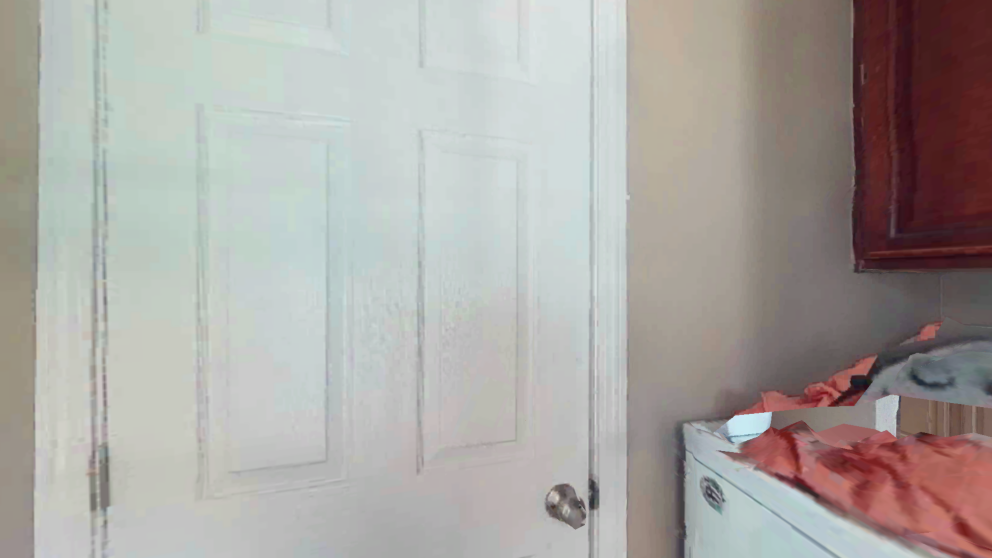
- Prediction
- dishwasher · <0.5 m
- Ground truth
- Not in view
Wrong distance

- Prediction
- picture · <0.5 m
- Ground truth
- picture · 3.1 m
False negative
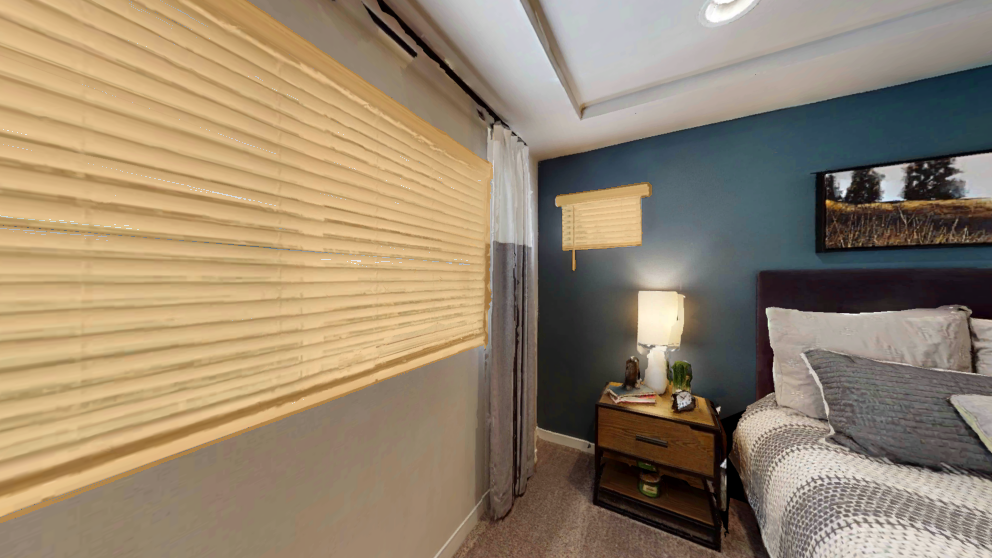
- Prediction
- Not seen
- Ground truth
- blinds in view
Goal recall and navigation success
Categories that perception reports more reliably also have higher navigation success. Small or thin objects are reported less often than large furniture, making goal recognition a target for improvement.
Conclusion
Progress through goal grounding
Goal grounding explains much of the gap between reaching an object and stopping successfully. Demonstrations teach search, while explicit grounding supplies the semantics and distance needed to finish the episode.
The same policy’s success rises from 69.6% to 91.6% with ground-truth grounding, near the expert’s 96.1%, on 2,309 HM3D-OVON val_unseen episodes under ours, clean. Better perception can improve navigation without retraining the policy, and corrected evaluation can credit those improvements.
Training still depends on annotated scenes, and evaluation is limited to static indoor simulation. Learning grounding from real videos and evaluating on real robots are the next settings in which to test this separation of perception and policy.
Citation
@article{liu2026stopwatch,
  title={StopWatch: Goal Grounding for Object-goal Navigation},
  author={Liu, Xinhao and Tian, Yunsheng and Qiu, Yuheng and Abbeel, Pieter and Chen, Xi and Shi, Guanya and Feng, Chen},
  journal={arXiv preprint arXiv:2610.23841},
  year={2026}
}